
I have already been asked this question many times, so I was also prompted to give it some more thorough thought: “Is Japanese difficult to learn?".
To quote my first Japanese teacher at the Technical University of Munich (TUM): “Japanese is difficult to learn, yes. But not more difficult than other foreign languages". Learning a foreign language is always difficult. You should never believe ads, which recently pop up ever so often in social media claiming that “you can learn any language in 14 days". To be proficient enough to actually be able to have a meaningful conversation, the effort is more in the order of magnitude of months to years, depending on your effort and motivation.
Whether learning Japanese is difficult for you depends upon what your native language is. As I am a German native speaker, let me take German as the base language as example.
Basically one can say that there are 3 major aspects of learning Japanese:
- Grammar & Vocabulary
- Writing systems
- Context
These are not phases that start after each other, but rather aspects that run in parallel. The following graphic shows my subjective opinion on when each aspect starts to become relevant during learning Japanese.
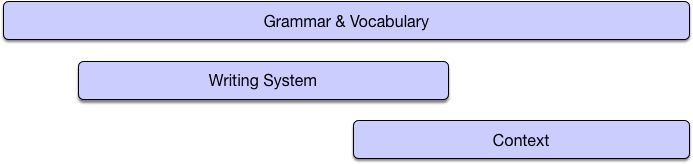
At first you start out learning vocabulary and simple grammar. Once you memorised a good handful of words, phrases and a bit of grammar, you will start learning the writing system and, especially while learning the Kanji, notice how learning vocabulary and Kanji goes hand in hand, supplementing each other. This means, that if you know a word already, memorising the matching Kanji is easier and vice versa.
Once you have a stable base of vocabulary, grammar, and Kanji, you will become more fluent in speaking, understand more of what is said to you directly and in conversations you are listening to. This is the point when you start learning the meaning of the context.
Context is a concept which may be familiar to linguists, but is usually never a topic in language schools. The context is something which a society as a whole has an informal agreement upon, loosely known as common sense. I blogged about context already here.
The English expression “this goes without saying" is a nice example. It is used to express that something is common sense, but the speaker feels it is necessary to stress it by speaking it out anyway.
This is what context is about. In daily communication, there are many things which do not need to be said, and yet everyone understands.
A simple example for context in Japanese vs. English would be the following phrase:
I will have coffee.
コーヒーにします。
Note that in Japanese, the “I" is omitted, and yet the sentence is perfectly valid and understandable.
Now, Germans have the urge to say “I" due to the fact that German is a very precise language that requires to speak out almost everything, so Germans learning Japanese often end up saying
私はコーヒにします。
By Japanese grammar, this is not wrong, however it emphasizes the “I" to the extent of saying something along the lines of
I don’t know about you, but I will have coffee.
Once you get the hang of context, you will stop adding the “I" to every sentence.
I have noticed that becoming more aware of the context increased my situational awareness of a conversation significantly. I observe and listen more carefully to better understand what my wife, colleagues and clients are saying.
Relying on the precision of my native language, I need less attention to the context. In Japanese, I need less attention to precision of language, but more attention to the context of the conversation.
It is this last aspect, in my opinion that is the most difficult to learn, because it comes with experience, and in language this means, reading, listening, talking to and watching native speakers. There are many languages that rely a lot on context as well, such as Chinese. For speakers of such languages, of course, understanding context will be the easy part.
Ultimately, the only meaningful purpose for learning a foreign language is to communicate with other people. This is the only genuine motivation for learning a new language, if you wish to ever be proficient. So paying close attention to the conversation and its context is surely a good thing to learn any language, no matter whether it is context or word driven.